Update 4: Does It Hold on Crude Oil? RSI and GARCH on WTI and Brent.
A reader asked the obvious next question. We had run our most consistent strategy across two cryptocurrencies and a tech stock, and volatility-sized it with GARCH in Update 3. Does any of it survive contact with a completely different asset class? So we pointed the exact same setup at crude oil. Oil is not crypto. It is driven by supply decisions, inventories, and geopolitics, and it has a long reputation for spiking and then reverting. If a mean-reversion strategy is going to work anywhere, it should work here. And if it does not, that tells us something too.
LMEX lists two crude contracts, and we tested both: WTI, which trades as OIL-PERP, and Brent, which trades as BRENT-PERP. There is no separate WTI-PERP ticker; OIL-PERP is the WTI contract.
The setup, unchanged
We changed nothing about the strategy. Same RSI(14) mean-reversion entries, same rolling one-day-ahead GARCH(1,1) volatility sizing, same costs. Only the market is new. Because these commodity contracts are newer listings, the windows are shorter than our crypto tests, which is a caveat we will not let you forget.
The results
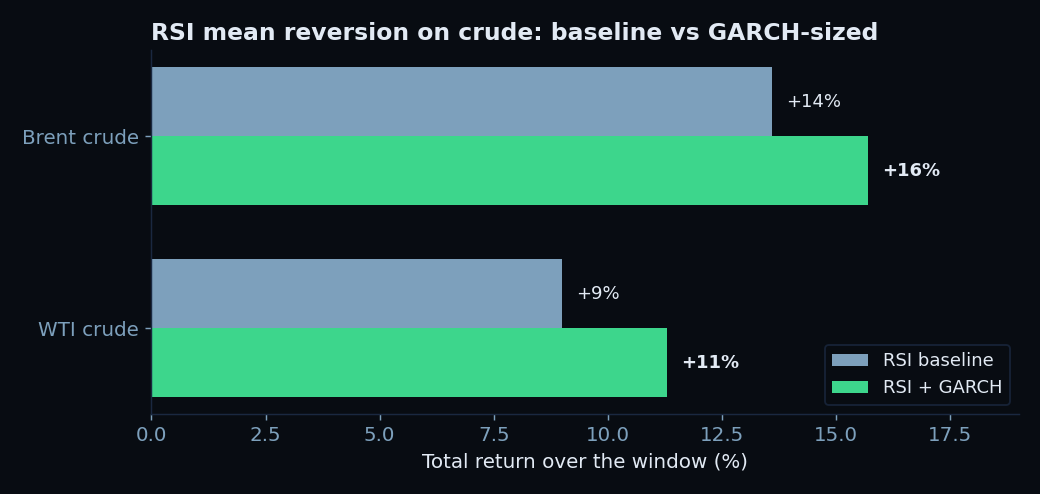
Two clean findings, and both echo the rest of the series.
Finding 1: mean reversion made money on crude
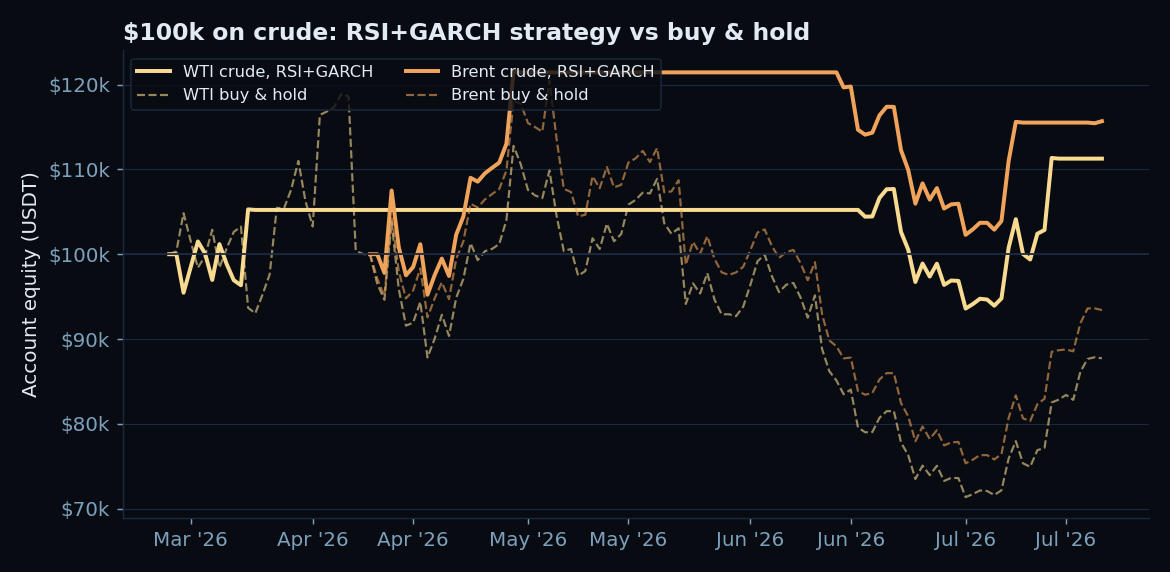
While both crude contracts drifted lower, the RSI reversion strategy was solidly positive on each: about +9% on WTI and +14% on Brent before the GARCH layer, with Sharpe ratios near or above 1.0. That extends this strategy's streak. It has now made money on Solana, Bitcoin, Nvidia, and both crude oils, which is four assets across three asset classes without a losing market yet.
This is not luck, and the reason matters. Oil is a naturally mean-reverting market. Prices jolt on an inventory number or a supply headline, then drift back as the shock is absorbed. That is precisely the behaviour a "buy the oversold, fade the overbought" strategy is built to harvest, which is the same reason it struggled in the cleanly-trending crypto bear of our first study and thrived in the choppier consistency window. The strategy did well on oil because oil is the kind of market it likes. Match the tool to the regime, and it works.
Finding 2: GARCH helped again
Adding the GARCH volatility layer improved both contracts, lifting WTI from +9.0% to +11.3% and Brent from +13.6% to +15.7%, with a higher Sharpe in each case. That is now four assets, SOL, BTC, WTI, and Brent, where sizing a mean-reversion strategy by its GARCH volatility forecast improved the result. The one asset where it did nothing, Nvidia, was the one whose volatility barely moved, so there was nothing to time. The pattern from Update 3 is holding up: GARCH sizing is a genuine, repeatable edge when it is paired with a strategy whose main risk is volatility, and reversion is exactly that strategy.
The cross-asset scorecard
Step back and look at where the mean-reversion-plus-GARCH combination now stands across everything we have tested.
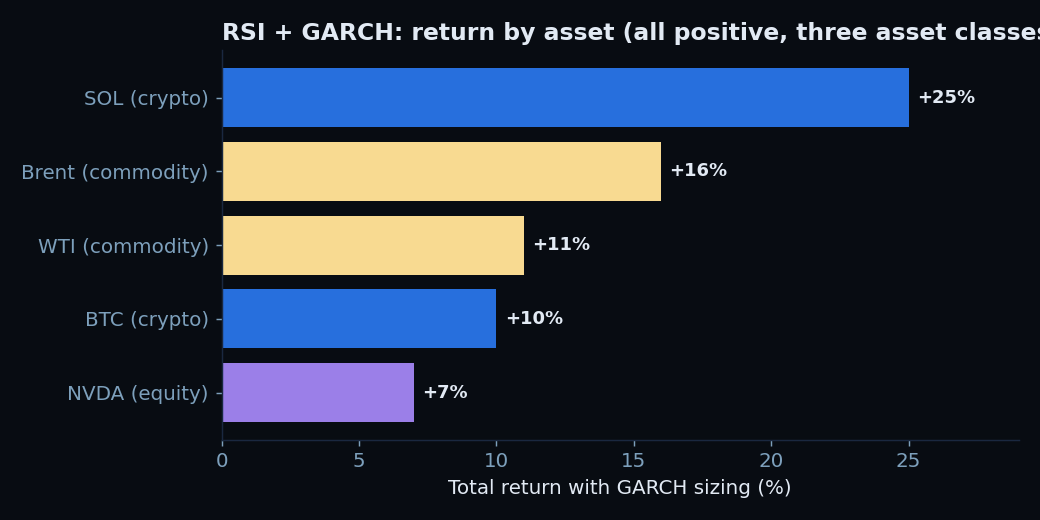
Five assets, three asset classes, every one positive. That is the most encouraging chart in the entire series, and we want to be careful not to oversell it. It is not proof of a holy grail. It is a strategy that fits the market conditions we happened to test, which were mostly choppy and range-bound, exactly the regime mean reversion loves. In a cleanly trending market it would struggle, as it did in our very first study. But within its regime, across wildly different assets, it has been remarkably consistent, and the GARCH layer has quietly improved it almost everywhere volatility actually moved.
The honest caveats
Three of them, and they are real. The crude windows are short, 100 to 130 days, because the contracts are newer than the crypto markets, so there is more room for luck than in the longer tests. We left funding out of these runs for simplicity, so treat the exact figures as indicative. And every window we have tested, oil included, was either falling or choppy. We still have not run this strategy through a sustained bull market, and mean reversion is precisely the style that a strong uptrend punishes. Until we do that test, "works everywhere" should read "works in the choppy and falling markets we have tried so far."
Run it on oil yourself
You can reproduce this in a minute. Take the script from Update 3, and instead of asking Claude to pull SOL-PERP candles from the LMEX connector, ask for OIL-PERP or BRENT-PERP. Everything else stays the same. That is the whole point of building the test on standard parts: pointing it at a new market is a one-line change.
Short mode: what if you only sell?
A natural follow-up: if oil is falling, why not just sell it? We tested three sell-only variants, and the answer is a clean lesson in why "the market is going down" and "short it" are not the same instruction.
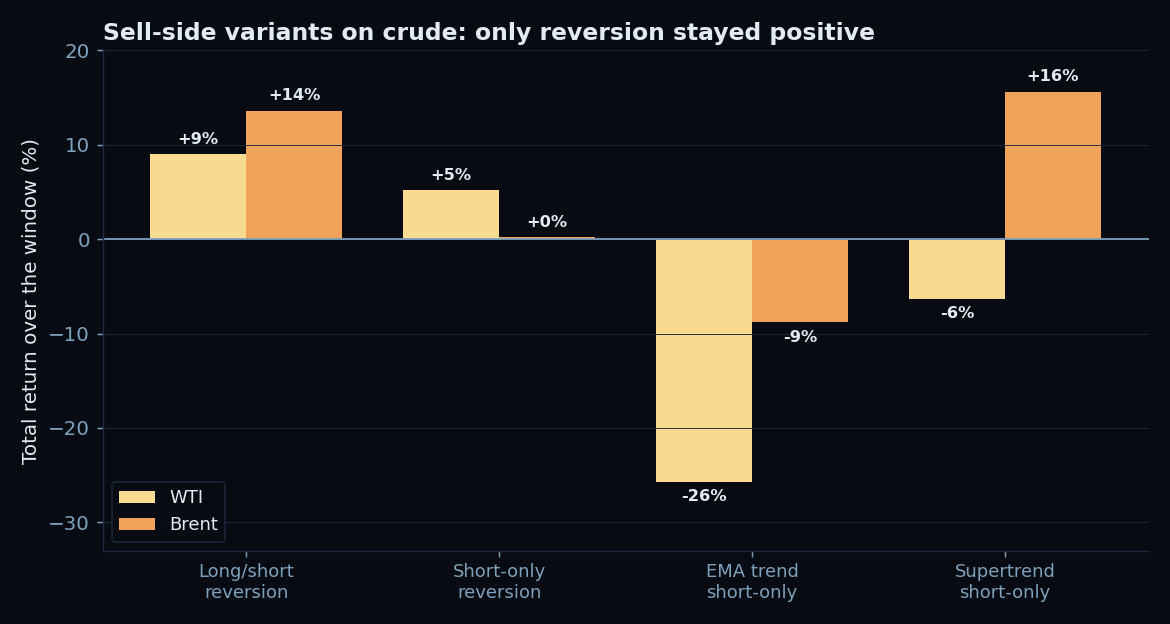
First, short-only reversion. Restricting our RSI strategy to only its short trades made it very safe and nearly idle. It fades overbought spikes, and a falling market rarely gets overbought, so it took a single trade on each contract, won both, and finished up +5.2% on WTI and a rounding-error +0.2% on Brent with almost no drawdown. Safe, but it leaves most of the money on the table, because the long/short version earned the bulk of its return buying oversold dips, not shorting.
Then the genuine bearish bet: short-only trend following, which shorts the downtrend itself. This is what most people picture when they say "sell mode," and it mostly failed. A plain EMA trend short lost on both contracts, badly on WTI at -25.7%, and Supertrend won on Brent but lost on WTI. The reason is the same theme that runs through this whole series. Oil fell, but it did not fall cleanly. The decline was choppy, full of sharp counter-rallies, and a trend-following short gets whipsawed in exactly that environment: it sells after a down-leg, then price snaps back and stops it out. A gentle, choppy 10% drop is a mean-reversion market wearing a bear costume, not a trend-following market.
So the honest answer to "can we run it in sell mode" is yes, but be careful what you mean. Fading rallies with a reversion short is safe and quiet. Shorting the trend to profit from the fall is the intuitive move, and it was the worst of the lot here, precisely because the fall was not a clean trend. The strategy that made the most money on falling oil was the one willing to buy the dips, not the one that only sold.
Frequently Asked Questions
Q: Does LMEX have a WTI contract?
Yes, it trades as OIL-PERP. There is no separate WTI-PERP symbol; OIL-PERP is the WTI crude contract, and BRENT-PERP is Brent crude. We tested both.
Q: Why does mean reversion work on oil?
Oil is a naturally mean-reverting market. It spikes on supply and inventory news, then drifts back as the shock fades. That is exactly the pattern a buy-oversold, sell-overbought strategy is designed to capture, which is why reversion suited crude better than it suited a cleanly trending market.
Q: Did GARCH help on oil too?
Yes, on both contracts. It lifted WTI from +9.0% to +11.3% and Brent from +13.6% to +15.7%, with a higher Sharpe each time. That makes four assets across three asset classes where GARCH sizing improved the reversion strategy.
Q: Can I trust these numbers?
Treat them as indicative. The windows are short because the contracts are new, funding was left out for simplicity, and every market we have tested was falling or choppy rather than trending. The direction of the result is consistent with the rest of the series, but it needs longer windows and a bull-market test before it is more than promising.